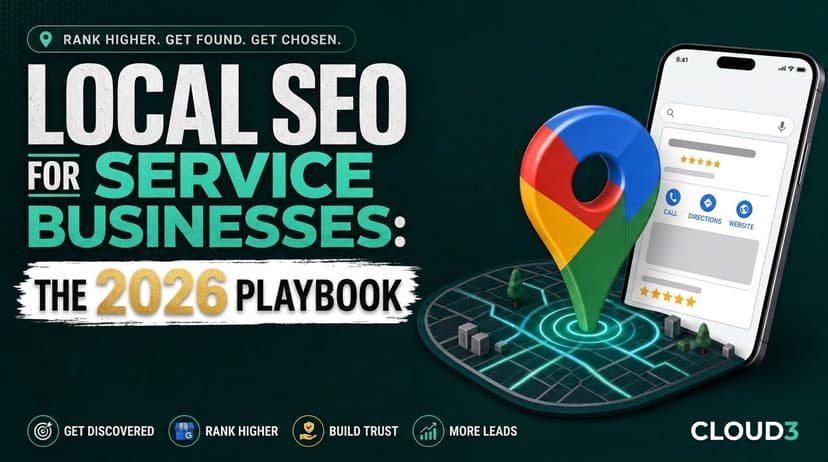



Your Google Business Profile is the most valuable page you do not actually own. For most local businesses it gets seen more often than the website, it drives the calls that come through the map pack, and it forms the first impression for nearly every "near me" search. Yet Google Business Profile optimization is still the highest-leverage hour a local business can spend on marketing, and most profiles are running at half power.
So this is the field guide: what to fix once, what to repeat weekly, and what quietly hurts you in the background.
The One-Time Foundations
Get these right one time and they pay you back forever.
Categories are the biggest lever most owners never touch. Your primary category heavily influences which searches you can even appear for, so be precise about it. Choose "Plumber," not the vague "Contractor." Then add every secondary category that genuinely applies to you. For example, a clinic that is also a cosmetic clinic and an emergency provider should claim all three.
Complete every field. Add services with descriptions, and prices wherever you have them. List your service areas if you travel to customers. Turn on attributes like wheelchair access or free parking. Fill in the opening date. Remember, every empty field is a question Google ends up answering by guessing, and it is one more reason a competitor's fuller profile can outrank yours.
Name, address, phone, exactly consistent. The name on the profile has to be your real business name, with no keyword stuffing, and the address and phone must match your website and directory listings character for character. Inconsistent listings quietly erode Google's trust in you. Here is one warning from experience: once your profile is verified, treat the address field as frozen. Editing it can trigger re-verification and pull your profile offline for weeks. So fix inconsistencies everywhere else to match the profile, never the other way around.
Photos of the real thing. Show the actual storefront, the actual team, and the actual work. Profiles with genuine, recent photos consistently earn more clicks and more direction requests than stock imagery ever will.
The Weekly Routine
Optimization is not a one-time setup. On the contrary, Google rewards the profiles that look alive.
Reviews, every week. A steady drip of genuine reviews is the strongest ongoing signal you can send, and your response matters almost as much as the review itself. Respond to every one, including the rough ones, and keep it brief and professional. We laid out a full system for this in our guide to getting more Google reviews.
Posts, most weeks. Share updates, offers, finished projects, and seasonal notes. Posts expire quickly, and that is exactly why a consistent cadence separates active businesses from abandoned-looking profiles.
Q&A, monitored. Anyone can ask a question on your profile, and anyone can answer it, including people who are simply wrong. So seed the common questions yourself with accurate answers, then check back regularly for new ones.
Photos, monthly. Add new jobs, new stock, and new-season shots. With photos, recency genuinely counts.
What the Profile Feeds Into
The profile does not work alone. Instead, map pack rankings blend your profile signals with your website's local relevance and your reputation across the wider web.
Your website has to confirm what the profile claims. That means the same name and address, city-specific pages for what you do, and LocalBusiness structured data that ties it all together. Your citations, meaning your listings on the major directories, also need to agree with the profile. Better yet, the whole system compounds. When we rebuilt Toronto Marine Rentals around a fully optimized profile and a matching website, they reached number one on Google and grew revenue 65 percent. The profile did the heavy lifting, and the site turned the click into a customer.
That connected build is the core of our local SEO service, and it is the difference between a profile that merely exists and a profile that actually produces.
Mistakes That Quietly Hurt
A few patterns come up constantly in our audits.
First, keyword-stuffed business names, like "Best Plumber Toronto | Emergency 24/7," violate the guidelines and risk suspension. Second, duplicate profiles for the same location split your reviews and confuse the rankings, so merge them. Wrong or generic categories then cap your visibility no matter what else you do right. Ignored reviews, and especially ignored negative reviews, read as abandonment to both Google and customers. Finally, hours that are wrong on a holiday weekend turn your single best search moment into a closed door.
None of these are hard to fix. All of them, however, are common.
Measuring Whether It Works
The profile's own performance data reports searches, views, calls, direction requests, and website clicks. Of those, watch the calls and direction requests most closely, because they signal customers rather than curiosity. Then pair that data with rank tracking across your service area. Map pack position varies block by block, and a profile that ranks first beside your office can be invisible four kilometres away. That block-by-block view is exactly what a rank-grid scan reveals, and it is how we verify the work is actually landing.
The Profile-to-Website Handshake
Google cross-references everything your profile claims against your website, and the mismatches cost more than most owners realize. The handshake itself has three parts.
Identity. The name, address, and phone on the site must match the profile exactly, both in the footer or contact page and in your LocalBusiness structured data, so that machines can confirm what humans read. Relevance. For every category and service the profile lists, the website should carry a real page, because a profile claiming "kitchen renovations" that links to a site never mentioning kitchens is a claim with no evidence behind it. Destination. The link from your profile should land somewhere that continues the searcher's intent. That is usually the homepage for brand searches, though a service or location page often converts better for profiles built around a single offer.
So audit the handshake once a quarter. Sites get edited, phone systems change, and the drift between profile and website is one of the quietest ranking leaks in all of local search.
A 30-Day Turnaround Plan
For a neglected profile, a single month of focused work covers nearly everything in this guide.
Week one is foundations. Verify access, fix the categories, complete every empty field, and correct the name, address, and phone everywhere they appear online. Week two is evidence. Add twenty real photos, write services with descriptions, and seed the Q&A with your five most common questions. Week three is momentum. The review request system goes live, ideally automated after each completed job, and your first post cadence begins. Week four is measurement. Baseline your calls, direction requests, and rankings across the service area, so the next month has something honest to measure against.
None of this is complicated. Still, all of it is the difference between a profile that exists and one that produces. The businesses that put in the month of work and then hold the routine are the ones sitting in the map pack a year later.