

Reviews decide who gets the call
Most local jobs are won before the first conversation. A customer searches, sees a short list, and reads the stars. The business with more recent reviews looks safer. That business gets the call.
Learning how to get more Google reviews is not a vanity project. It is one of the highest-leverage moves a service business can make. Reviews shape where you rank on the map. They shape whether someone trusts you enough to reach out. And they compound. Every new review makes the next lead easier to close.
This is a practical system. We will cover why reviews win local jobs, how to ask without feeling awkward, how to automate the request, and how to respond so every review works twice. No theory you cannot use tomorrow.
Why reviews win local jobs
Think about how a homeowner picks a plumber. They rarely read your website first. They open Google, type the service and their city, and scan the map pack. Three businesses show up. The choice usually comes down to two numbers. Star rating and review count.
A four-point-nine with two hundred reviews beats a perfect five with six. Volume signals that many people took the risk and were happy. That is social proof doing the selling for you before you say a word.
Reviews feed local ranking
Google's local algorithm weighs three broad factors. Relevance, distance, and prominence. Reviews sit inside prominence. The quantity, quality, and recency of your reviews all send signals about how established and trusted you are.
Recency matters more than people expect. A steady drip of fresh reviews tells Google you are active and open for business. A page that stalled two years ago looks dormant. That is why a review system beats a one-time review push. You want a small, reliable flow every week, not a spike and then silence.
Keyword-rich reviews help too. When a customer writes "they fixed our leaking water heater in Etobicoke," that phrase adds real-world relevance to your profile. You cannot script this, but you can prompt for it gently.
Reviews build trust before contact
Ranking gets you seen. Trust gets you chosen. Those are two different jobs.
Reviews are the trust layer. They answer the quiet questions every buyer has. Will these people show up on time? Will the price hold? Will they clean up after? A specific, recent review answers all three without you making a single claim about yourself.
This is why review growth belongs inside any serious local SEO strategy. Visibility and credibility are not separate goals. They are the same funnel, and reviews power both ends of it.
The system to ask for reviews
Most businesses do not have a review problem. They have an asking problem. The work is great. Customers are happy. Nobody ever asks them to say so.
A good review system removes the awkwardness by making the ask normal, timed, and easy. Three parts. Ask at the right moment, make the path frictionless, and follow up once.
Ask at the moment of peak happiness
Timing beats persuasion. The best time to ask is right after you deliver a clear win. The repair works. The lawn looks sharp. The customer says thank you. That is your window.
Ask too early and the job is not done. Ask too late and the feeling has faded. Train your team to recognize the moment and ask on the spot, in person, while the good feeling is fresh. A simple line works. "If you were happy with today, a quick Google review would mean a lot. It takes about a minute."
Make the path one tap
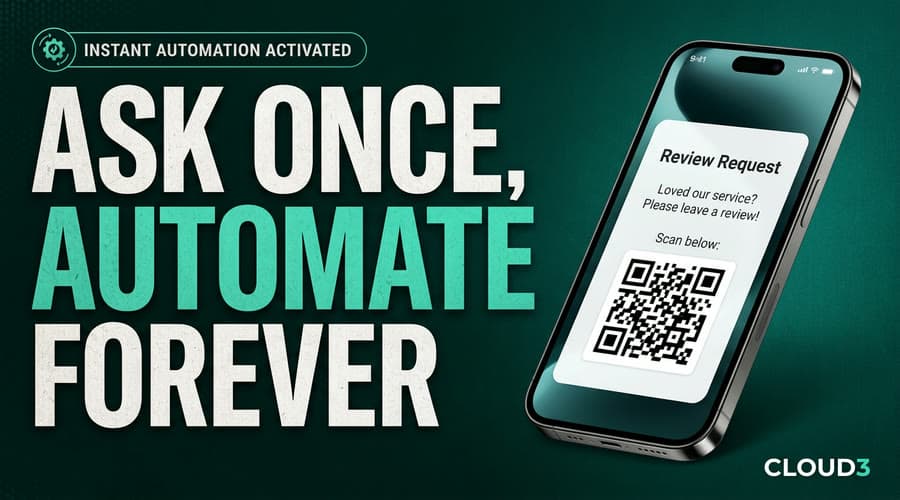
Every extra step loses people. Do not tell a customer to "find us on Google." Hand them a direct link to your review form. Use your Google review short link, a QR code, or a text message with the link inside.
A QR code on the invoice, the truck, or a thank-you card turns intention into action. The customer scans, the review box opens, they type, they are done. You just removed every reason to put it off.
Follow up once, then stop
Some people mean to leave a review and forget. One polite follow-up recovers a large share of them. A short message a day or two later does the job. "Thanks again for having us out. If you have a minute, here is the link to leave a review." Send it once. Do not nag. Repeated requests damage the goodwill you just earned.
How to automate reviews the right way
Doing this by hand works until you get busy. Then it stops. Automation makes the system survive a full schedule. The goal is not to remove the human touch. It is to make sure the ask always happens, even on your worst week.
Trigger requests from a real event
The cleanest automation ties the review request to something that already happens. A job marked complete in your CRM. An invoice paid. A service appointment closed. That event fires the request automatically, so nobody has to remember.
Most modern CRMs and scheduling tools can do this. When a job closes, the system waits a set number of hours, then sends a text and an email with your review link. The customer gets asked at the right time, every time, with zero effort from your team.
Keep the message human
Automated does not mean robotic. Write the message the way you would say it out loud. Use the customer's name. Reference the service. Keep it short. One clear link. The best automated requests read like a text from a person, not a system notification.
Split the channel too. Some people respond to text, others to email. Sending both, spaced a little apart, lifts your response rate without feeling pushy.
Watch the rules
A few guardrails keep you safe. Never buy reviews or offer payment for them. It violates Google's policies and can get your reviews removed or your profile penalized. Do not gate reviews by screening for happy customers first and routing unhappy ones elsewhere. Ask everyone the same way.
Volume is good, but a sudden flood of reviews from nowhere can look unnatural. A steady, event-driven flow is both safer and more believable. Build for consistency, not a one-week spike.
How to respond to reviews
Getting the review is half the work. Responding to it is the half most businesses skip. Every response is public. Future customers read them. Your replies are content, and they tell a story about how you operate.
Respond to positive reviews with specifics
A generic "Thanks for the review" is a missed chance. Reference the actual job. "Glad we could get your furnace running again before the cold snap. Thanks for trusting us, Maria." That reply does three things. It shows you were really there, it adds keywords, and it shows future readers that you care after the money changes hands.
Aim to respond to every review. It signals an active, attentive business, and Google notices engagement on your profile.
Handle negative reviews with calm
Negative reviews are not the disaster they feel like. A profile with only five stars can read as fake. A few honest critiques, handled well, actually build trust. What matters is your response.
Stay calm. Never argue. Acknowledge the concern, take it offline, and show you want to make it right. "I am sorry this fell short of what we promised. I would like to fix it. Please call me directly at the number below." Future readers judge you far more on how you handle a complaint than on the complaint itself.

Turn reviews into fuel
Your best reviews should not sit on one page. Pull them into your website, your ads, and your social posts. A strong review on a service page raises conversion. The same words that won trust on Google win it everywhere else.
This is where reviews connect to the rest of your presence. Feeding review content into your site supports your broader SEO and content efforts, because fresh, specific, customer-written language is exactly what search engines and buyers both reward.
Putting the system together
None of these steps is hard on its own. The advantage comes from running all of them, every week, without gaps. Ask at the right moment. Make it one tap. Automate the trigger. Respond to every review. Repeat.
Do that for a few months and the math changes. Your review count climbs. Your map ranking improves. Your close rate rises because the trust work is done before the call. The businesses that dominate local search are rarely the cheapest or the biggest. They are the ones with a review engine that never stops.
If you want to see how this plays out in real numbers, our case studies show how local service businesses turned a steady review flow into more inbound calls and booked jobs.